
Featured Space Capsule Models for Manila Deployments
Explore our highest-rated factory-direct smart capsule housing units engineered for rapid deployment in high-density urban areas and tropical coastal destinations.

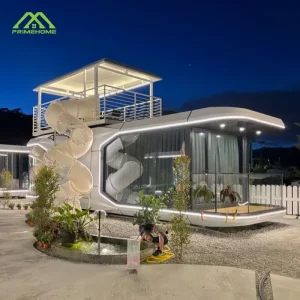


1. Metro Manila & Philippine Architectural Transformation: The Prefab Space Capsule Imperative
Metro Manila, as the economic core of the Philippines, represents one of the most densely populated urban landscapes in Southeast Asia. Encompassing sixteen cities—including Makati, Bonifacio Global City (BGC), Pasay, Quezon City, and the historical Port Area—the National Capital Region (NCR) faces an unprecedented intersection of challenges: surging land values, protracted construction timelines, stringent local zoning mandates, and extreme vulnerability to tropical weather anomalies. For real estate developers, hospitality operators, and commercial entities operating within Manila, conventional wet-construction methods (masonry and poured-in-place concrete) increasingly present unacceptable capital exposure and operational bottlenecks.
In response to these structural market realities, prefabricated spacecraft-style space capsules have emerged as a disruptive modular housing technology. Manufactured off-site under controlled factory conditions, space capsules deliver a precision-engineered alternative that circumvents local labor shortages, bypasses prolonged site disruption, and dramatically accelerates Return on Investment (ROI). Whether deployed as rooftop luxury suites in Makati, eco-glamping units along the coastal stretches of Batangas and Nasugbu (accessible via Manila transportation hubs), or agile commercial pop-ups in Eastwood City, space capsules represent the apex of contemporary off-site construction (OSC).
Information Gain Metric: Traditional structural builds in Metro Manila average 12 to 18 months in permitting and civil works. Factory-fabricated space capsules delivered via Manila South/North Harbor require less than 48 hours of on-site assembly, cutting project delivery timelines by over 75%.
2. Global Industrial Trends & Space Capsule Architectural Taxonomy
Globally, the modular infrastructure market is transitioning from basic container conversions to monolithic, highly insulated, aerodynamic smart capsules. Driven by the expansion of experiential tourism, green building certifications (such as LEED and BERDE in the Philippines), and mobile lifestyle micro-trends, international developers are prioritizing structures that minimize environmental displacement while maximizing aesthetic footprint.
Unlike repurposed ISO shipping containers—which suffer from thermal bridging, restricted interior clearance, and structural degradation when modified—purpose-built space capsules are built around a engineered structural steel skeleton enveloped in marine-grade aluminum alloy plating. This creates a self-supporting monocoque shell offering optimal strength-to-weight ratios, essential for both seismic resilience and maritime shipping.
Comparative Structural Matrix: Space Capsules vs. Conventional Alternatives
| Evaluation Parameter | Factory Space Capsule | Shipping Container Conversion | Traditional Concrete Build |
|---|---|---|---|
| Structural Integrity | Q355B Galvanized Frame + Aircraft-grade Aluminum | Cor-Ten Steel (Requires internal reinforcement) | Reinforced Concrete / Hollow Block (Weight-heavy) |
| Thermal Insulation | 100mm Polyurethane Spray (R-Value > 25) | Retrofitted Rockwool (Prone to thermal leaks) | Standard Cavity Wall (High HVAC load) |
| On-Site Civil Works | Minimal (Point foundation / steel piers) | Moderate (Leveling & structural framing) | Extensive (Deep excavation & curing) |
| Typhoon Resistance | Aerodynamic (Resists Category 5 Typhoons) | High (Flat surfaces create drag) | High (Permanent, non-relocatable) |
| Relocatability | 100% Relocatable via Standard Crane & Trailer | Moderate (Heavy crane requirement) | 0% (Permanent land locks) |
3. Industrial Synergy: Suzhou PrimeHome Factory Manufacturing Dominance
As an established global lead manufacturer located in Suzhou, China's core modular industrial zone, Suzhou PrimeHome Technology Co., Ltd. bridges high-end manufacturing precision with cost-optimized supply chains for buyers serving Manila and broader Philippine markets. Operating out of a state-of-the-art 28,000 m² production facility with a monthly throughput exceeding 5,000 units, PrimeHome controls every stage of the space capsule fabrication lifecycle.
Precision Metallurgy
Robotically welded Q355B structural steel chassis subjected to hot-dip galvanization and anti-corrosion fluorocarbon painting, exceeding C5 maritime durability standards.
IoT Smart Systems Integration
Factory-integrated voice control systems, automated smart curtains, keyless RFID access control, and pre-wired 220V/60Hz electrical infrastructure built to Philippine standards.
Factory Acceptance Testing (FAT)
100% waterproof testing under high-pressure simulated rainfall showers, thermal imaging leaks check, and structural flex tests performed prior to export packing.
Direct-from-factory procurement eliminates intermediate markups common among local trade re-sellers in Manila. By leveraging China's complete industrial supply ecosystem, PrimeHome achieves up to 40% cost efficiency over locally assembled prefabricated alternatives, while ensuring strict adherence to international building standards (CE, ISO9001, and structural compliance aligned with the National Structural Code of the Philippines - NSCP).
4. Tropicalization & Microclimate Engineering for the Philippine Environment
Deploying architectural hardware in Manila and across Luzon requires specialized engineering designed for high humidity, marine salt spray, torrential monsoons, and seismic activity along the Marikina Valley Fault System. Standard off-the-shelf prefabricated units fail prematurely when subjected to these harsh environmental factors. PrimeHome implements four distinct engineering protocols for all space capsules bound for Manila:
A. Seismic & Typhoon Structural Anchoring
Each capsule features heavy-duty corner castings and lower chassis tie-down brackets engineered to lock onto ground screws, concrete pads, or elevated steel stilts. The curved monocoque exterior diffuses wind pressures exerted during Category 5 super typhoons (wind speeds exceeding 240 km/h), while flexible frame connectors absorb lateral ground displacement during seismic events.
B. Thermal Radiation Mitigation & HVAC Efficiency
Manila's tropical climate generates extreme solar heat gain. PrimeHome capsules incorporate double-glazed Low-E tempered glass panels filled with Argon gas, reducing Solar Heat Gain Coefficient (SHGC) down to 0.28. Combined with high-density polyurethane wall insulation, the required cooling load for internal inverter air conditioners is reduced by 45%.
C. Marine-Grade Anti-Corrosion Barrier
For coastal installations in coastal Manila Bay or neighboring resorts, metal oxidation is the leading cause of structural failure. PrimeHome utilizes fluorocarbon aluminum alloy cladding (100% rustproof) secured with stainless steel 316 fasteners, preventing degradation caused by high ambient salinity.
D. Integrated Moisture & Drainage Control
Monsoon season brings intense rainfall. Our capsules feature hidden interior drainage channels integrated directly into the roof frame columns. Vapor barriers prevent condensation accumulation within wall cavities, preserving structural wall panels and indoor air quality.
5. Strategic Commercial Applications Across Metro Manila & Key Destination Hubs
The versatility of PrimeHome space capsules enables high-value capitalization across diverse market segments in the Philippines:
1. Rooftop Urban Boutique Lodging (Makati, BGC, Pasay)
Unlocking unutilized urban space atop existing commercial concrete structures. Due to their lightweight structural profile, space capsules can be lifted via mobile crane onto building roofs in Manila's business districts, transforming empty roofs into high-yield luxury boutique micro-suites with skyline views.
2. Eco-Resort & Glamping Destinations (Batangas, Tagaytay, Laguna)
Weekend tourism spots catering to Manila residents require low-impact development options. Space capsules require minimal ground disturbance, preserving natural landscapes while offering high-ticket futuristic accommodations that command premium nightly rental rates on booking platforms.
3. Mobile Business Hubs & Real Estate Sales Showrooms
Developers launching residential townships across Cavite, Bulacan, or Pampanga can deploy space capsules as temporary, high-impact mobile sales centers. Upon project completion, the capsule can be hitched to a flatbed trailer and relocated to the next site.
4. Emergency Command Centers & Executive Site Housing
For large-scale infrastructure projects along the Manila Bay land reclamation sites or North-South Commuter Railway (NSCR), capsules serve as climate-controlled, mobile operational headquarters and executive living quarters for engineers.
6. End-to-End Procurement, Freight & On-Site Installation Roadmap
Procuring space capsules from China to Manila is executed through a streamlined 5-stage B2B supply chain protocol designed to guarantee risk-free delivery and instant operational readiness:
Stage 1: Design Locking & Local Code Match
Selection of capsule dimensions (e.g., 5.8m, 8.5m, 11.5m length), floor plans, electrical voltage compliance (220V 60Hz), and local plug configurations. Detailed CAD floor plans finalized.
Stage 2: Factory Fabrication & QA
30-day structural assembly in our Suzhou facility. Client receives live video inspections, thermal leak test recordings, and finished interior walk-through validation.
Stage 3: Export Packing & Ocean Freight
Capsules are wrapped in multi-layer protective ocean shrink-wrap and secured onto 40ft Flat Rack or Open Top ocean containers. Shipped via direct sea routes to Manila South Harbor or Manila North Harbor (Transit time: 5-7 days from Shanghai/Ningbo).
Stage 4: Customs Brokerage & Local Transit
Coordination with local Manila customs brokers for fast clearing of import duties and taxes. Flatbed low-loader trucks deliver units directly from Manila port to site location across Luzon.
Stage 5: Mobile Crane Placement & Hookup
A standard 25-ton mobile crane lifts the capsule onto prepared foundation pads or steel piers. On-site plumbers and electricians execute plug-and-play connections for water inlet, sewage outlet, and main power within hours.
Planning a Space Capsule Project in Manila?
Our technical team provides layout CADs, foundation loading blueprints, and complete freight estimates straight to Manila Port.
Send Inquiry NowComplete Space Capsule & Modular Living Catalog
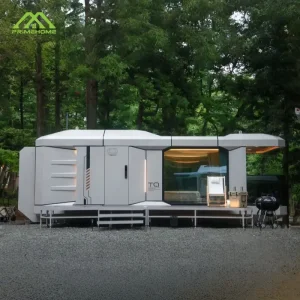
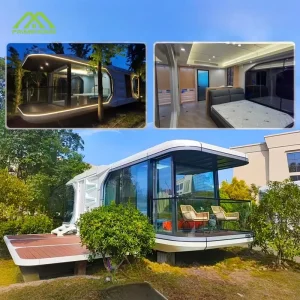
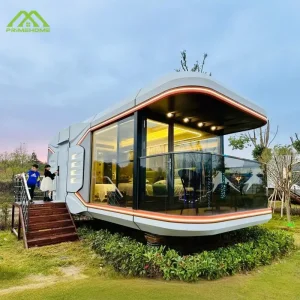
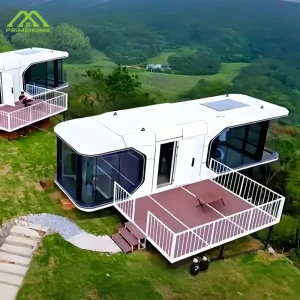
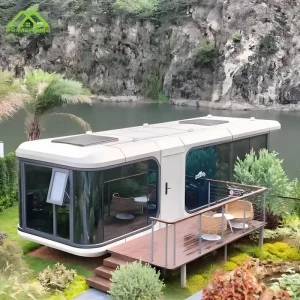
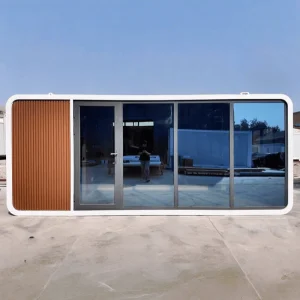
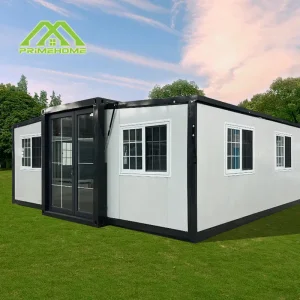
Browse our extensive line of customizable space capsule rooms, mobile villas, and expandable modular cabins available for wholesale and custom project supply.

Frequently Asked Questions: Space Capsule Supply to Manila
Technical, logistical, and commercial inquiries answered by PrimeHome's senior engineering team.
Do PrimeHome space capsules comply with Philippine electrical and plumbing standards?
Yes. All units bound for Manila and the Philippines are pre-wired at our factory to match 220V / 60Hz power specifications. Circuit breakers, wiring gauges, and socket outlets comply with the Philippine Electrical Code (PEC). Plumbing pipelines are pre-installed with standard PPR/PVC piping and standard NPT/G-thread connectors compatible with local municipal water hookups.
What building permits are required to install a space capsule in Metro Manila?
Because space capsules are classified as relocatable modular structures, permitting requirements are significantly simpler than permanent wet-construction. In many cases, if positioned on steel piers or temporary foundations, they require only standard local Barangay clearances and developer site location permits. For urban rooftops in Makati or Pasay, structural weight verification by a local civil engineer is recommended (which PrimeHome supports with dead-load data sheets).
How do PrimeHome space capsules perform during intense Philippine typhoons?
PrimeHome space capsules feature an aerodynamic, rounded monocoque exterior constructed from Q355B galvanized steel structural frames and aviation-grade aluminum alloy panels. This curved surface minimizes wind drag. When properly anchored to ground foundations using our high-tensile steel tie-down kits, the structures are engineered to withstand wind pressures up to 240 km/h (equivalent to Super Typhoon conditions).
What is the ocean freight lead time from China factory to Manila Port?
Production lead time at our Suzhou factory is typically 25 to 30 days depending on custom interior specifications. Transit time by sea from Shanghai Port or Ningbo Port directly to Manila South or Manila North Harbor takes approximately 5 to 7 days. Customs clearance and local low-bed trailer transport to your site across Luzon adds another 2 to 4 days.
Can these space capsules be transported to island destinations like Palawan, Boracay, or Siargao?
Absolutely. Capsules are shipped from China in standard 40ft Flat-Rack or Open-Top ocean containers to Manila Port. From Manila, units can be transferred via domestic Ro-Ro (Roll-on/Roll-off) vessels or barge freight to peripheral island groups across the Visayas and Mindanao, making them ideal for island eco-resorts.
What thermal insulation is used to handle Manila’s hot tropical humidity?
Our capsules employ high-density polyurethane (PU) spray insulation (up to 100mm thickness) within wall and ceiling cavities, offering superior insulation values over traditional fiberglass or expanded polystyrene (EPS). Windows feature double-glazed Low-E tempered safety glass filled with Argon gas to reflect solar infrared heat and prevent internal moisture sweating.
Accelerate Your Modular Real Estate Project in Manila
Partner directly with Suzhou PrimeHome Technology Co., Ltd.—your expert space capsule manufacturer. Contact our B2B export team today to receive complete technical catalogs, CAD layout templates, and factory-direct pricing for Manila delivery.